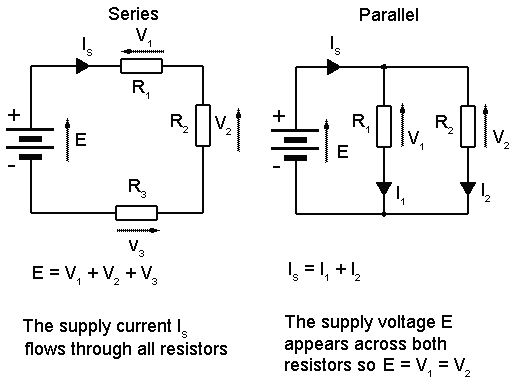
Today i´m going to explain the main formulas needed to calculate a theoretical circuit.
There are two different kind of circuits PARALLEL & SERIES CONNECTION
SERIES CONNECTION
Here the resistances are connected in series, but what´s a resistance?
Resistance is the electrical resistance of an electrical element measures its opposition to the
passage of an electric current. The SI unit of electrical resistance is the ohm (Ω).
In this kind of connection the Total Resistance will be the sum of the differente resistances. In this case:
RT= R1+R2+R3
PARALLEL CONNECTION
In this case the remittances are connected in parallel . Here the way to sum the resistances is different. We sum it like this:
1/RT=1/R1+1/R2+1/R3
This formula is 1/RT so don´t forget to turn up the final result and write the correspondent units.
Another interesting formula o be mentioned is the Ohm´s law
Ohm's law states that the current through a conductor between two points is directly proportional of the potential difference across the two points. Introducing the constant of proportionality, the resistance,one arrives at the usual mathematical equation that describes this relationship:
-

- where I is the current through the conductor in units of amperes, V is the potential difference measured across the conductor in units of volts,and R is the resistance of the conductor in units of ohms. More specifically, Ohm's law states that the R in this relation is constant, independent of the current.
-
The Kirchoffs law stablishes that the difference of potential in a closed circuit it`s 0.