sábado, 3 de marzo de 2012

ANALYZING IN DIFFERENT WAYS

There are many ways in which we can analyze a circuit, the main processes are:


·  EQUIVALENT CIRCUITS
      1.-Circuits in series or in parallel
      2.-Star- triangle transformation
      3.-In a general way by elimination of the node in the net
      4.-Transformation of the sources


1.-


2.-
3.-


4.-


We also can analyze a circuit in a practical way using the materials explained in the first entrance.
The most common way in which e analyze a circuit is the series and parallel calculating method or the practical one. To solve some simple circuits is possible to do it by hand using the operations that I´ve already comment in other posts, but there are computer programs that makes our lives easier and allows us to design our circuit and does the pertinent calculations such as, Multisim.

Here i leave you a sample video of what Multisim consists in.


viernes, 2 de marzo de 2012

CALCULATING & FORMULAS

Today i´m going to explain the main formulas needed to calculate a theoretical circuit.


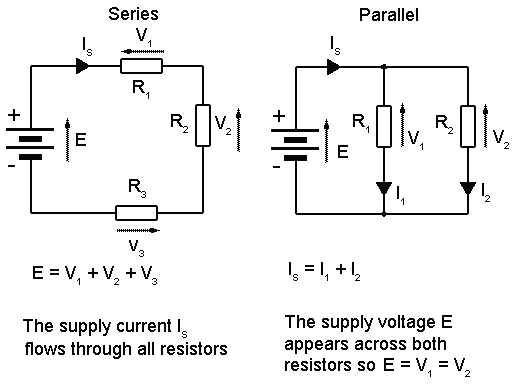
There are two different kind of circuits PARALLEL & SERIES CONNECTION


SERIES CONNECTION


Here the resistances are connected in series, but what´s a resistance?
Resistance is the  electrical resistance of an electrical element measures its opposition to the passage of an electric current. The SI unit of electrical resistance is the ohm (Ω). 
In this kind of connection the Total Resistance will be the sum of the differente resistances. In this case:
                                   
                                                                          RT= R1+R2+R3


PARALLEL CONNECTION


In this case the remittances are connected in parallel . Here the way to sum the resistances is different. We sum it like this:

1/RT=1/R1+1/R2+1/R3

This formula is 1/RT so don´t forget to turn up the final result and write the correspondent units.

Another interesting formula o be mentioned is the Ohm´s law
Ohm's law states that the current through a conductor between two points is directly proportional of the potential difference across the two points. Introducing the constant of proportionality, the resistance,one arrives at the usual mathematical equation that describes this relationship:
                                                                  I = \frac{V}{R}

where I is the current through the conductor in units of amperes, V is the potential difference measured across the conductor in units of volts,and R is the resistance of the conductor in units of ohms. More specifically, Ohm's law states that the R in this relation is constant, independent of the current.


The Kirchoffs law stablishes that the difference of potential in a closed circuit it`s 0.


lunes, 27 de febrero de 2012

SYMBOLS


To make a proper circuit, we have to have certain knowledge of some terms, such as, whats an open or close circuit. If we see it alive we can affirm what would be an open one or close one, it´s obvious.


CLOSED CIRCUIT                                                   OPEN CIRCUIT


But when we grow it to plasm what we are doing before just doing it´s much more difficult if you don´t know the symbols so today it´s what we are going to do, learning some useful symbols.

In this picture we can se the most common symbols to show if a circuit is open or closed or what type of current is passing through it.

         1)      Wires not joined.                             1) Voltage AC source
         2)      Inductor                                             2) Wires joined.  
             3)  Resistor                                             3) Switch (open)
         4)    Voltage DC source                          4) Current source
         5)     Capacitor     


There are more symbols that have to be taken into account, like finding the value of the bands in the resistors. This is nearly easy and this diagram shows you how to do it.


domingo, 26 de febrero de 2012

IMPORTANT PIECES OF A CIRCUIT

In this blog we are going to learn how to analyze a circuit.


First of a lll we have to now some basic things about the material required to produce a circuit, so in the first post this is what i´m going to explain.
To make a circuit in a practical way we require some basic things such as:


STRIPBOARD


Stripboard is a widely-used type of electronic prototyping board characterized of regular (rectangular) grid of holes, with wide parallel strips of copper cladding running in one direction all the way across one side of the board. In using the board, breaks are made in the tracks, usually around holes, to divide the strips into multiple electrical nodes. With care, it is possible to break between holes to allow for components that have two pin rows only one position apart such as twin row.

RESISTOR


resistor is a passive two terminal electrical componen that implements electrical resistance as a circuit element. The current through a resistor is in direct proportionto the voltage across the resistor's terminals. Thus, the ratio of the voltage applied across a resistor's terminals to the intensity of current through the circuit is called resistance. This relation is represented by Ohm´s law.


WIRE
 
It´s use to carry the electricity through the circuit.

CROCODILE CLAMP


It´s a simple mechanical device for creating a temporary electrical connector.


POWER SUPPLY


MULTIMETER


multimeter is an electronic measuring instrument that combines several measurement functions in one unit.


power supply is a device that supplies electrical energy to one or more electric loads.

Once we now this terms we are ready to prepare and analyze an electric circuit.